The story
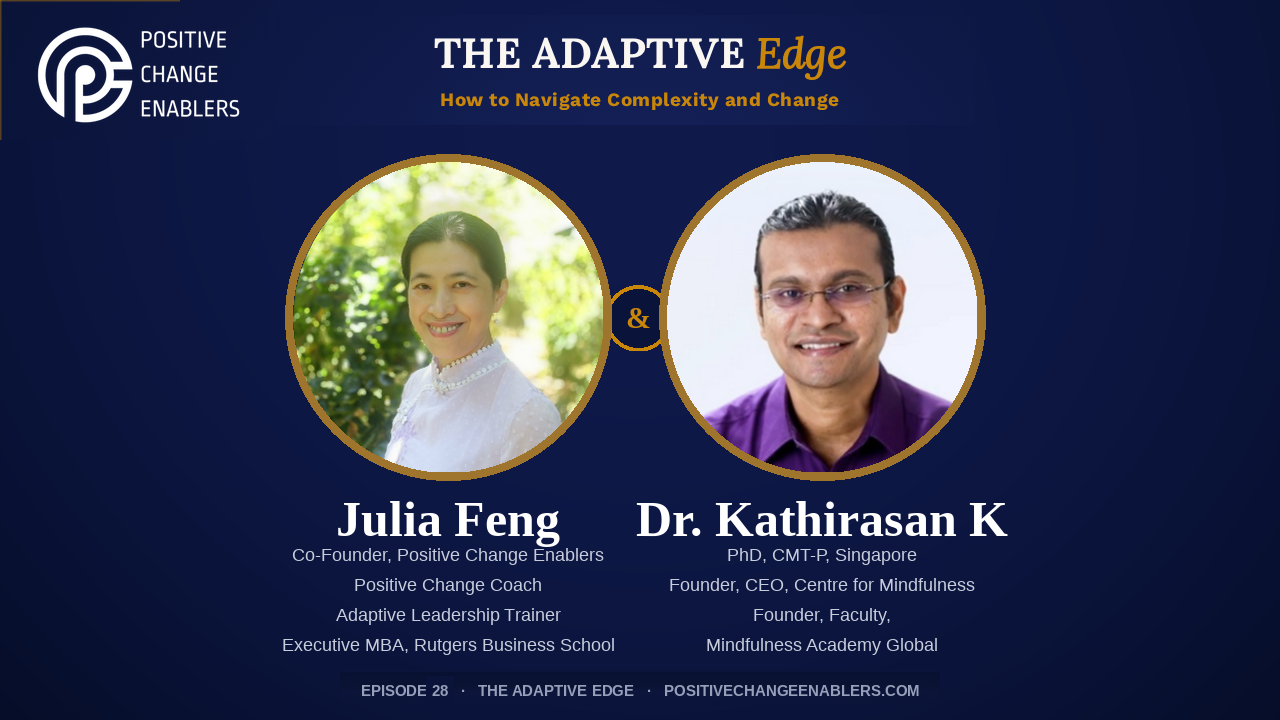
Dr. Kathirasan K, known to friends as Kathir, is the founder of the Centre for Mindfulness in Singapore and of Mindfulness Academy Global.
For him, COVID was the greatest complexity he has faced. It permanently changed how people learn, and with it the whole field of learning and development where his work sits.
“Ride that wave as opposed to try to oppose it.”
The skill at work: Self-Regulation (Skill 8)
Self-Regulation is the skill of staying grounded when the storm is outside your control. Kathir’s tools came from mindfulness: pause, notice, accept, and then respond.
He chose to ride the wave
Kathir’s first move was not to fight the change. The complex world, he says, requires us to “find ways to ride that wave as opposed to try to oppose it.” That might mean starting something new, stopping something, or changing what you do.
He turned lockdown into a self-retreat
Stuck at home, the only time he went out was to walk his dogs. Kathir used that time as an inner retreat, to ask deeper questions: who am I, and how are these problems affecting me?
He noticed the birds were not worried
Walking in the park next to his home, Kathir saw that the birds, the animals and the life in the river were not affected. COVID was a human problem. That realization let him look at problems from the perspective of the self, from the inside out.
He used the four mechanisms of mindfulness
Awareness: take a step back and notice what is happening, including his own emotions and thoughts, without judgment. Attention: direct it to what might work. Acceptance: bring a non-reactive stance to what he could and could not control, because “reacting to situations would only make it worse.” From these three came insight.
He stopped expecting the world to be simple
Kathir explains that an emotion comes from how we interpret something, not from the thing itself. If we expect the world to be simple, complexity feels like a threat. When we accept that the world will always be complex, calm follows, and that calm gives us space to respond rather than react.
He calms the body first
When anxiety is strong and lasting, Kathir says, it is hard to think your way out of it. Start with the body: box breathing, a body scan, or progressive muscle relaxation. Then work with your thoughts.
What happened
Kathir now teaches small, everyday practices to busy people, like noticing the brush on your gums when you brush your teeth. His reminder to his team: do your best right now, because whether it bears fruit is “not entirely in our hands.”
Try this
The next time a change unsettles you, take three slow breaths before you reply. Then ask yourself: am I upset by what is happening, or by how I am interpreting it?
More stories
Staying grounded in the jungle: Edwin Song’s story of Self-Regulation →
A mind no wall could hold: Zenaida Willison’s story of Self-Regulation →
A new rock every day: Thomas De Brun’s story of Self-Regulation →
Feed your mind: Andy Clark’s story of Self-Regulation →
This article is our interpretation of Kathir’s story, based on the conversation on The Adaptive Edge Podcast. The framework names are ours; the events and lessons are his own.